Land Rover LRX Geneva Concept, 2008


BOLD EVOLUTION
The LRX concept marks a bold evolution of Land Rover design, signalling the brand's potential shift into new areas of the market, while remaining true to its core values. As the company celebrates its 60th anniversary during 2008, the three-door LRX, with its more compact size, lighter weight and sustainability-focused technologies, clearly addresses the needs of a changing world and offers the potential of 120 g/km CO2 emissions and fuel economy of 60 mpg (4.7 l/100km) on the European combined cycle.
COMPACT AND PREMIUM
LRX is described as a cross-coupé and dramatically extends the scope of what Land Rover represents. Though 149 mm (5.9 in) shorter than the Freelander 2 / LR2 and 205 mm (8.1 in) lower, LRX is conceived as a premium car, designed to appeal to new customers in the luxury and executive sector - those who want many of the benefits of a 4x4 and the presence of a larger vehicle, but in a more compact package.
The first all-new Land Rover revealed since Gerry McGovern became the company's design director, LRX is a natural extension of the Land Rover range, complementing the existing models and helping to define a new segment. Its many recognisable Land Rover design cues include bold new interpretations of the signature clamshell bonnet, the floating roof and the solid 'wheel-at-each-corner' stance.
Its compact size is one of its greatest assets, which will appeal to anyone who wants the versatile ability of an agile 4x4 with the cachet of the Land Rover name. In addition, its lower weight and the reduced aerodynamic drag resulting from the smaller frontal area would help give significant gains in fuel efficiency and reduced CO2 emissions.
HIGHLY EFFICIENT POWERTRAIN
The white LRX is conceived as a highly fuel-efficient 2.0-litre, turbodiesel hybrid, capable of running on bio-diesel. In combination with other Land Rover technologies, this powertrain could reduce fuel consumption by as much as 30% compared with other 4x4s of comparable size, and reduce CO2 emissions to approximately 120 g/km.
LRX's improved efficiencies are the result of advanced mechanical and electrical energy-saving elements, which are combined to achieve cumulative gains in many areas.
The concept's integrated Electric Rear Axle Drive (ERAD) is particularly significant in Land Rover terms as it would allow LRX to use electric drive alone at lower speeds while retaining full (even improved) 4x4 ability in tough conditions. Unlike the hybrid technology used by some 4x4 rivals, Land Rover's unique solution retains mechanical drive to all four wheels.
Off-road, the ERAD would provide additional torque only when it is needed, and with maximum electrical torque from standstill, this solution offers even better low-speed control and enhanced pull-away on difficult surfaces (such as packed snow or wet grass) or when towing.
On the road, the ERAD would allow low-speed traffic creep up to 20 mph (32 km/h) on electric power alone, with the Integrated Starter-Generator (ISG) function re-starting the engine automatically when needed. The electric drive would then continue to assist the mechanical drive until the engine is running in its most efficient range, benefiting both fuel consumption and CO2 emissions.
The ISG would also stop the engine automatically when the vehicle halts in traffic, so the engine does not idle needlessly, and restart it quickly and smoothly as required.
The electrical drive system uses power stored in a dedicated high-voltage, high-capacity, lithium-ion battery pack, independent of the normal 12-volt battery. This is charged by a regenerative braking energy system, also working through the ERAD.
LRX also incorporates Hill Descent Control and Land Rover's acclaimed and user-friendly Terrain Response system, which optimises vehicle drivability and comfort, as well as maximising traction. On LRX, this has five modes, including the new and efficiency-focused 'Eco' mode. Principally for on-road use, this configures all the integrated elements of the car's system for optimised fuel economy. The other four Terrain Response modes provided are sports (also new), general driving, sand and 'grass/gravel/snow' (a single programme for slippery surfaces).
EXTENDING 'BREADTH OF CAPABILITY'
The positioning of LRX could be described as moving subtly from traditional SUV to crossover, with its more car-like appearance and dynamics that are sportier and on-road biased. But while its character is underlined by excellent agility, handling and performance, LRX also promises the widest breadth of capability in the class.
The design of LRX was developed entirely in-house by Gerry McGovern's team, driven by a passion to create a car that truly represents Land Rover's future thinking. It has a very dynamic profile, with a distinctive taper to the floating roofline and a muscular shoulder running the length of the car, accentuated by the rising beltline. The glazing wraps right around LRX, with no exposed pillars, creating a bold design graphic. The architectural structure of the upper body can be glimpsed through the windows and roof - echoing some of the best contemporary buildings.
Pushing the wheels out to the four corners helps give the car its purposeful stance, and its front-end design makes a powerful and instantly recognisable statement of Land Rover's identity. The carefully sculpted corners dramatically reduce the car's visual overhangs front and rear.
There are new interpretations of Land Rover's traditional clamshell bonnet, distinctive headlamps and perforated two-bar grille. The car has jewel-like, tapering blade indicator clusters front and rear, and the wheelarches are wide but softly integrated, housing highly polished, 20-inch alloy wheels.
The fine detailing includes additional polished aluminium in the form of side-strips, side and bonnet vents, and the exterior door releases, which are concealed in the car's shoulders. Graphic details such as these appear to be 'punched out' of the smooth body surfaces rather than overlaid on them. The 'frosted' white paint colour was especially developed for LRX and its visual depth helps to highlight the car's form.
IMPECCABLE, PREMIUM INTERIOR
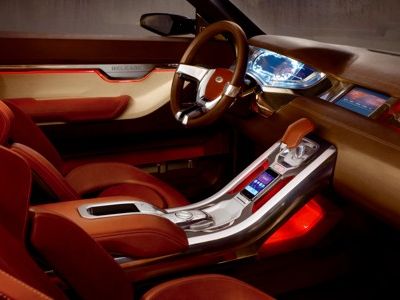
The interior of the LRX concept clearly demonstrates how a compact Land Rover can still be roomy, practical, versatile - and sophisticated. The impeccably executed cabin features a combination of soft leathers in rich tan and dark chocolate, with polished aluminium details, while the visible structures of the seats, instrument panel and roof architecture not only give a highly distinctive look but also help save weight.
The 'fast' sloping architecture of the centre console reflects LRX's sporty dynamics, as does the distinctive binnacle over the instrument cluster. The electronic display uses 'floating' LCD graphics to create a three-dimensional look that can be personalised for different drivers, as well as interacting with LRX's touch-screen display.
The instrument graphics present data in layers depending on their level of importance, to give maximum relevant information with minimum distraction. When appropriate, displayed information transfers between the main instrument cluster and the touch screen. Further adding to LRX's involving personality, different Terrain Response modes are matched by changes in the cabin's background 'mood' lighting colour - green in 'Eco', red in sports and blue in general driving and off-road modes.
CLEVER USE OF SPACE
Though LRX is compact, clever use of space makes it impressively roomy, and many neat design touches maximise its practicality. A second touch-screen area gives a fully interactive display and control for LRX's iPhone docking facility.
There is also a coolbox, plus a bottle chiller that can be clipped to the lowered tailgate. The tailgate also has integral aluminium cupholders between two padded seating areas, for a new twist on the idea of a traditional Land Rover tailgate lunch.
Every interior design detail combines to maximise both actual space and the feeling of space. The clear roof is supported by a 'spider' frame running into the A-pillars, and the rear quarter pillars have glazed apertures for improved visibility and a lighter feel in the cabin.
SUSTAINABLE PRODUCT DESIGN
The exposed structures of the seats, roof and instrument panel are just one novel approach that Land Rover's designers have taken to reduce vehicle weight. Another example is replacing the glass for the side windows and roof with polycarbonate from SABIC Innovative Plastics, which is around 40% lighter. The polycarbonate also blocks virtually all UV light (protecting interior materials from fading), while special nano-technology within the material reduces infra-red transmission, helping to keep the interior cool.
TECHNICAL SPECIFICATIONS
* Length: 4351 mm / 171.3 in
* Width (excluding mirrors): 1895 mm / 74.6 in
* Width (including mirrors): 2083 mm / 82.0 in
* Height: 1535 mm / 60.4 in
* Wheelbase: 2660 mm / 104.7 in
* Engine (proposed): 2.0-litre turbodiesel
* Fuel economy (potential): 60 mpg, 4.7 l/100 km (on European combined drive cycle)
* CO2 emissions (potential): 120 g/km (on European combined drive cycle)